Tools
AI Dev Tools Landscape 2025: Build, Ship, and Operate Faster
Dec 5, 2025
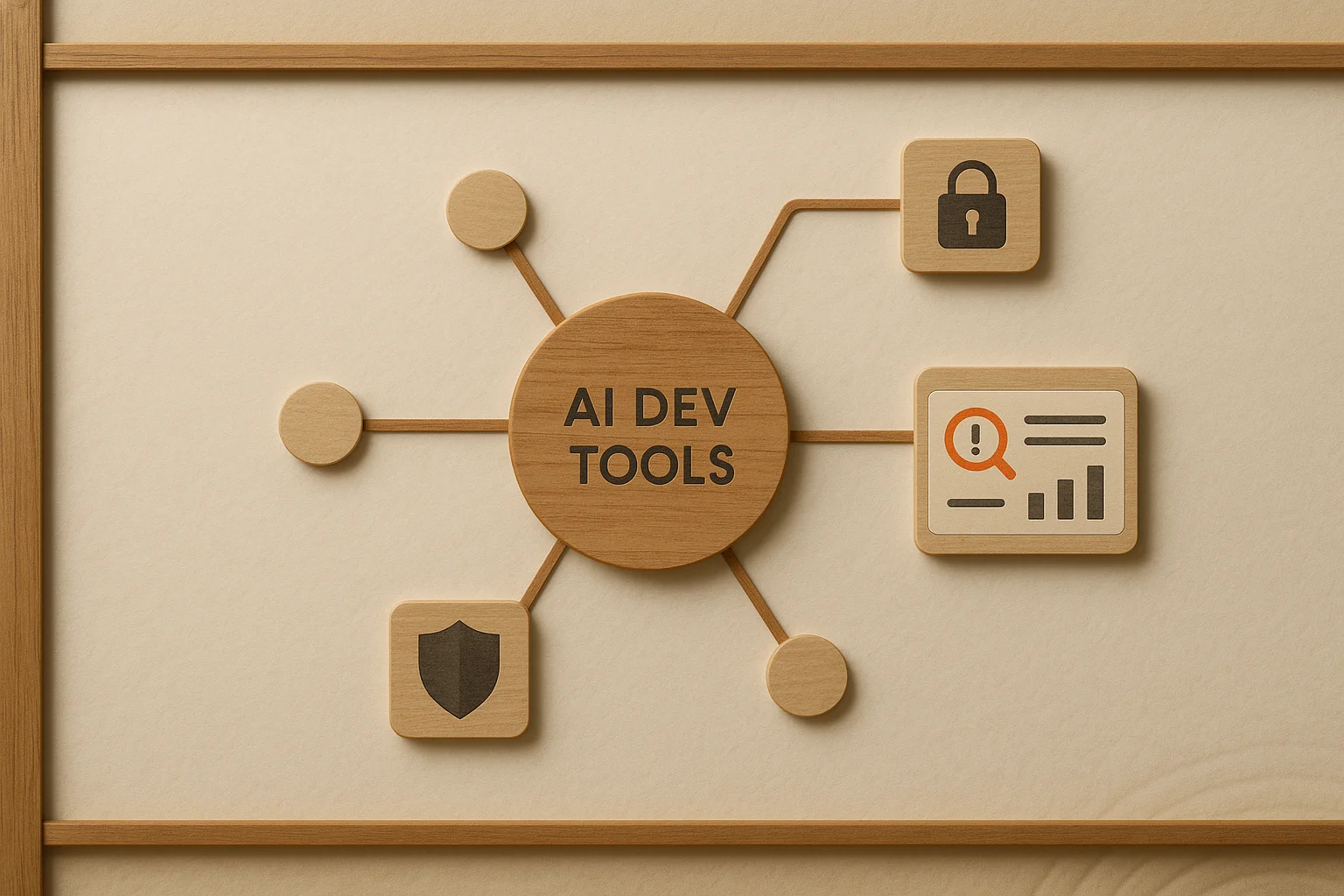
The AI dev tools landscape in 2025 spans assistants, review automation, testing, security, observability, and research. This guide organizes the category so you can assemble a stack that reduces cycle time without sacrificing governance. Lead with Propel Code for PR review and policy automation so every change ships with evidence. We also include how Google Antigravity supports discovery without accessing code, and point to focused guides on
review automation
and AI testing.
TL;DR
- Anchor your stack with PR review and policy automation.
- Add repo-aware IDEs for fast edits and test generation.
- Keep deterministic security and testing as the source of truth.
- Use observability to feed production context back into coding.
- Use Antigravity for research and synthesis of public knowledge.
Assistants and IDEs
Cursor, Windsurf, and JetBrains AI handle code navigation and refactors. Choose based on language fit and latency. Keep AI suggestions behind human review and CI checks.
Code review and policy
Propel automates PR review, enforces knowledge base rules, and provides analytics. Pair it with branch protections so every change is verified before merge.
Testing and quality
Use AI to draft unit and integration tests, then strengthen assertions. Keep Playwright or Cypress for E2E and ensure AI generated tests run in CI. Track flaky rates and fix before adding more automation.
Security and compliance
Secret scanning, SCA, and code scanning remain essential. AI can summarize findings and propose fixes, but deterministic scanners decide pass or fail. Log evidence for audits.
Observability and feedback loops
Sentry AI and Datadog AI translate incidents into actionable work. Feed that context into PR reviews so engineers see production impact while coding.
Research and discovery
Antigravity helps teams scan public docs and competitor updates. Keep it separate from code to avoid leaks. Store summaries in your knowledge base so review tools can reference them.
Good, better, best stacks
Good: Propel for PR review, one AI IDE, secret scanning, basic tests, Antigravity for research
Better: Add evals for AI features, contract tests, and cost observability for model usage
Best: Full policy packs, advanced SLOs, automated fix suggestions, and org-wide prompt libraries
Risk register and procurement questions
Data residency and training: where data is stored, how long, and whether it trains models.
Identity and access: SSO, SCIM, role-based permissions, and audit log exports.
Controls: rate limits, IP allowlists, and granular scopes per repo or project.
Support: SLAs, incident response paths, and rollback options for outages.
Compliance: SOC 2, ISO 27001, and evidence packages for security reviews.
Instrumentation must-haves
- Prompt and cost tracing with per-feature attribution.
Latency SLOs and error codes from orchestration through model endpoints.
- Tagging of AI-authored lines in PRs for later quality audits.
- Weekly dashboards for acceptance rate, noise, and rollback counts.
Adoption sequencing
Phase 1: Code review and policies with Propel; keep deterministic scanners blocking.
Phase 2: AI IDEs for a pilot squad; standardize prompt library and training.
- Phase 3: Testing automation and observability feeds into PRs.
Phase 4: Research assistants like Antigravity with strict data scopes.
Phase 5: Org-wide rollout with SSO, SCIM, audit exports, and monthly reviews.
FAQ
How do we avoid tool sprawl?
Standardize on one tool per category, keep a data-handling register, and measure usage. Drop tools that duplicate capabilities or add noise.
How should we sequence adoption?
Start with code review and IDEs, then layer testing automation, then observability feeds. Add research tools like Antigravity last to avoid data sprawl and keep governance simple.
To bring consistency to AI driven workflows, add Propel to your GitHub org. It enforces policies while letting teams experiment with the rest of the AI stack safely.
Sources and further reading
SLSA framework
for supply-chain controls to pair with AI tooling.
NIST AI Risk Management Framework
for governance across AI-assisted development.
GitHub code scanning
as a deterministic layer alongside AI review and generation.
Next

Best Practices
AI Agent Inventory: What to Track and How to Build One
Build an AI agent inventory that records ownership, access, cost, outcomes, and lifecycle state so your organization can govern agents securely as they scale.
Comparison
LM Arena Coding Leaderboard: Insights for Developers
A current May 2026 snapshot of the LM Arena Code Arena leaderboard, what changed, and how engineering teams should turn rankings into safer model routing.

Best Practices
AI-Resistant Technical Evaluations: How to Review Engineers in the Coding-Agent Era
Technical interviews and take-homes need to change now that coding agents can beat legacy exercises. Use this playbook to evaluate steering, verification, and judgment instead of pretending AI is absent.