AI Models
How Knowledge Distillation Works: An Academic Guide for Engineers
Feb 23, 2026
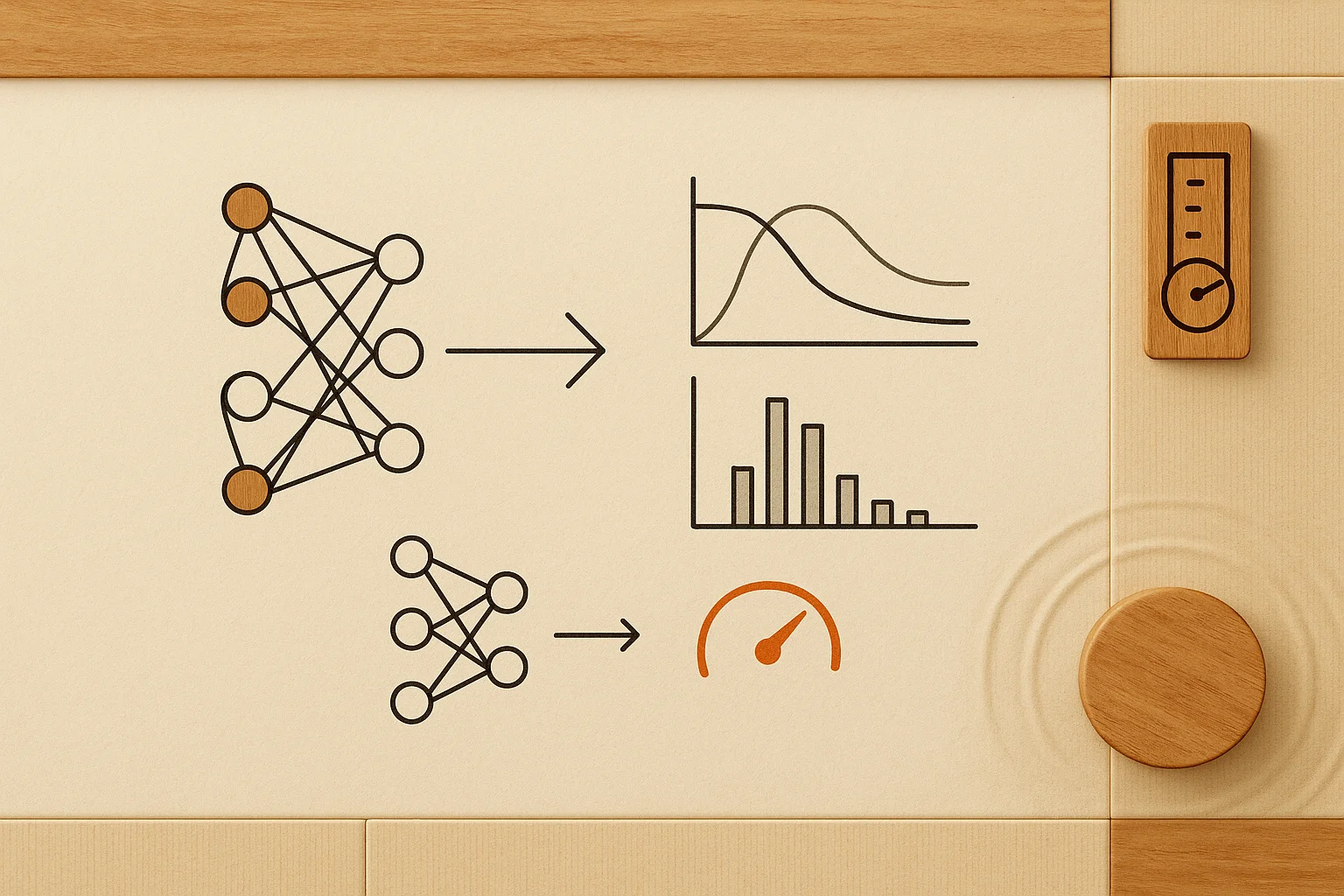
Knowledge distillation is one of the most practical ideas in modern model compression: transfer behavior from a larger teacher model to a smaller student while preserving as much task performance as possible. This article is intentionally academic and implementation focused. It assumes you already understand gradient-based training, cross-entropy, and basic transformer architecture.
Scope and assumptions
Audience: Engineers with AI experience who want a precise training mental model, not a product overview.
Focus: Supervised distillation objectives, representation transfer, regime design, and diagnostics.
Exclusions: Legal/policy analysis and vendor-specific distillation attack narratives.
Key takeaways
Distillation combines a hard-label supervised loss with a soft-target matching loss, usually KL divergence at elevated temperature.
Temperature and capacity gap are first-order controls. If either is wrong, optimization becomes unstable or under-informative.
Modern pipelines rarely rely on logits alone. Hidden-state, attention, and relation losses often improve student sample efficiency.
Offline, online, self-distillation, and teacher-assistant regimes solve different optimization constraints. Pick regime by data and compute budget.
Reproducible evaluation is required: report calibration, latency, and robustness, not just top-1 accuracy.
1. Formal Problem Setup
Let teacher logits be z_t(x) and student logits be z_s(x) for input x. A
canonical objective from Hinton et al. uses temperature-scaled distributions
and combines soft and hard supervision:
p_t^T = softmax(z_t / T)
p_s^T = softmax(z_s / T)

L_KD = T^2 * KL(p_t^T || p_s^T)
L_CE = CE(y, softmax(z_s))

L_total = alpha * L_KD + (1 - alpha) * L_CE
The T^2 factor corrects gradient scale changes induced by temperature.
Without it, large T weakens the KD gradient. In practice, you tune T and
alpha jointly.
2. Why Soft Targets Help Beyond One-Hot Labels
Hard labels provide only the target class. Teacher soft targets encode class similarity structure, often called dark knowledge. For example, if the teacher assigns non-trivial probability mass to semantically nearby classes, the student receives richer geometry than a one-hot vector can provide.
This is why KD can improve optimization even when teacher and student are trained on the same dataset: the student learns relative preference among alternatives, not only binary correctness.
3. Distillation Signal Taxonomy
Distillation methods can be grouped by what is transferred from teacher to student:
Response-based (logits/probabilities)
Match output distributions with KL or CE under temperature scaling. Baseline approach in Hinton et al.
Feature-based (intermediate states)
Match hidden representations at selected layers using L2, cosine, or projection heads. FitNets and TinyBERT use this pattern.
Attention-based (map transfer)
Align attention maps or derived attention statistics. Useful in transformer students with fewer heads/layers.
Relation-based (sample geometry)
Transfer pairwise or triplet relations in representation space. Relational KD focuses on structure between samples, not only pointwise matches.
4. Regime Design: Offline, Online, Self, and Teacher-Assistant KD
Regime selection changes both optimization dynamics and compute cost:
| Regime | Teacher behavior | When it works best |
|---|---|---|
| Offline KD | Frozen pretrained teacher | Most production settings with stable teacher checkpoints |
| Online KD | Teacher and student co-train | Large-budget training where co-evolution may help |
| Self-distillation | Model teaches later versions of itself | Regularization and incremental quality gains |
| Teacher-assistant KD | Intermediate assistant bridges capacity gap | Very small student vs very large teacher |
5. Distillation for Transformers and LLM Pipelines
For transformer students, distillation usually mixes token-level and representation-level constraints:
Token-level KD: match teacher token distribution at each position.
Sequence-level KD: train on teacher-generated sequences to reduce search mismatch between training and inference.
Hidden-state KD: align selected layer outputs using projection heads when dimensions differ.
Attention KD: align attention maps, optionally normalized per head.
DistilBERT and TinyBERT are canonical NLP examples: both combine output and intermediate signal transfer, with TinyBERT emphasizing layer-wise transformer distillation.
6. Minimal PyTorch-Style Training Loop
A compact pattern for response-based KD with hard-label blending:
teacher.eval()
for batch in loader:
    x, y = batch
    with torch.no_grad():
        z_t = teacher(x)
    z_s = student(x)

    p_t = torch.softmax(z_t / T, dim=-1)
    log_p_s = torch.log_softmax(z_s / T, dim=-1)
    kd = torch.nn.functional.kl_div(log_p_s, p_t, reduction="batchmean") * (T * T)

    ce = torch.nn.functional.cross_entropy(z_s, y)
    loss = alpha * kd + (1.0 - alpha) * ce

    optimizer.zero_grad()
    loss.backward()
    optimizer.step()
7. Hyperparameters That Matter Most
Temperature T: common search range is roughly 2-8. Too low behaves like hard labels; too high can flatten useful class structure.
Alpha weighting: tune with capacity in mind. Smaller students often need stronger CE support early, then higher KD weight later.
Layer mapping: for feature KD, map teacher-to-student layers explicitly and use projections for shape mismatch.
Data curation: KD amplifies teacher behavior. If teacher errors are systematic in a slice, students inherit them quickly.
Capacity gap: an extreme gap can make direct KD inefficient. Teacher assistant strategies can stabilize optimization.
8. Common Failure Modes and Diagnostics
Student under-capacity
Symptom: KD loss plateaus high while CE keeps dropping. Response: reduce teacher complexity, add assistant model, or simplify objective.
Teacher calibration issues
Symptom: student confidence inflates without accuracy gain. Response: calibrate teacher or reduce KD weight for high-entropy regions.
Domain shift between KD data and target data
Symptom: strong validation on distillation split, weak production metrics. Response: re-balance distillation corpus and include domain-specific CE anchors.
Optimization instability from objective imbalance
Symptom: loss oscillation and degraded convergence. Response: schedule alpha, warm-up with CE, and control gradient norms on auxiliary KD heads.
9. Evaluation Protocol for Engineers and Researchers
Do not evaluate distillation with a single scalar metric.
Primary task quality: accuracy/F1/exact match on in-domain and stress slices.
- Calibration: ECE or Brier score when confidence quality matters.
Efficiency: latency percentiles, memory footprint, and throughput at target batch size.
Robustness: perturbation and domain-shift checks relative to teacher baseline.
Ablations: isolate logit KD, feature KD, and regime choices independently.
Frequently Asked Questions
When does distillation outperform plain fine-tuning?
Usually when the teacher has materially better generalization and the student has enough capacity to absorb that signal. Distillation then acts as a structured target prior.
Do teacher and student need the same tokenizer?
Not strictly, but mismatch complicates token-level KD. If tokenizers differ, feature- or sequence-level objectives are often easier to stabilize.
Is logits-only distillation enough for transformers?
It can work, but many transformer students improve with intermediate-state and attention transfer, especially when depth differs significantly.
How much distillation data is typically needed?
Enough to cover the operational data manifold. In practice, data quality and slice balance matter more than raw volume once the corpus is reasonably representative.
Further Reading (Primary Sources)
Hinton et al. (2015),
Distilling the Knowledge in a Neural Network
Romero et al. (2014),
FitNets: Hints for Thin Deep Nets
Zagoruyko and Komodakis (2016),
Paying More Attention to Attention
Kim and Rush (2016),
Sequence-Level Knowledge Distillation
Mirzadeh et al. (2019),
Improved Knowledge Distillation via Teacher Assistant
Jiao et al. (2019),
TinyBERT
Sanh et al. (2019),
DistilBERT
Park et al. (2019),
Relational Knowledge Distillation
Gou et al. (2020),
Knowledge Distillation: A Survey
Next

Best Practices
AI Agent Inventory: What to Track and How to Build One
Build an AI agent inventory that records ownership, access, cost, outcomes, and lifecycle state so your organization can govern agents securely as they scale.

Comparison
LM Arena Coding Leaderboard: Insights for Developers
A current May 2026 snapshot of the LM Arena Code Arena leaderboard, what changed, and how engineering teams should turn rankings into safer model routing.

Best Practices
AI-Resistant Technical Evaluations: How to Review Engineers in the Coding-Agent Era
Technical interviews and take-homes need to change now that coding agents can beat legacy exercises. Use this playbook to evaluate steering, verification, and judgment instead of pretending AI is absent.